 |
With Our Compliments:
Making Textbooks Work for You
ADAPT TEXTBOOKS
FOR SPECIAL CIRCUMSTANCES
No textbook is perfect Sometimes you may have to customize it to suit your needs and those of your
students.
- Just as secular textbooks may be criticized for ethnic stereotyping, so may some Jewish
textbooks.
- Discussions of holiday or life cycle observance may concentrate on customs prevalent among
Ashkenazi Jewry. Bring in visitors who celebrate differently: Sephardic, Iranian, or Iraqi Jews. If this is
impossible to arrange, create a collection of photographs or artifacts: a Yemenite wedding, an Ethiopian
Passover celebration, a Sephardic babynaming.
- If the contributions of women have been overlooked, turn a negative into a positive by asking students
to create a supplement to their text featuring women who have been neglected by the authors of the text.
You will need to provide the students with some guidance as to where to find this material. Some places to
start are the following:
Baskin, J. R. (1991). Jewish Women in Historical Perspective.
Detroit: Wayne State University Press.
Henry, S. (1978). Written Out of History: A Hidden Legacy of Jewish Women Revealed Through Their Writing
and Letters.
New York: Bloch Publishing Co.
Koltun, E., Ed. (1976). The Jewish Woman: New Perspectives.
New York: Schocken.
Shepherd, N. (1993). A Price Below Rubies: Jewish Women as Rebels and Radicals.
Cambridge, MA: Harvard University Press.
- Update outdated historical and geographical information by assigning tasks to student "editors" or
editorial teams. Such exercises reinforce the notion that knowledge is fluid and teaches students to think and
act like historians and geographers. Tap into artistic talent by affording students the opportunity to make new
illustrations, charts, and maps.
- Ask students to add a personal dimension to textbooks on Jewish holidays. How are these
holidays celebrated in the synagogue? In their homes? Create a class supplement to the textbook. You might try a
similar supplement to a textbook on Israel if there are students who have been to Israel or whose parents can
contribute stories, maps, photographs, and other artifacts.
- No Jewish history text can tell the story of every community. Create a supplement to your
textbook by asking the students to produce a local Jewish history. Include maps, the story of Jewish landmarks and
institutions, and oral histories of older residents.
Sometimes you may have one or more copies of an outdated text Here are some suggestions as to how to
recycle an old textbook:
- Compare and contrast: How is a subject treated differently in different texts? (This is a
particularly effective strategy for a social studies topic: Jewish history or a course on Israel.) Not only is this
exercise a great way to point out the dynamic nature of scholarship, but it teaches critical thinking skills.
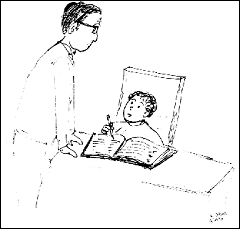
"Oh, no. I'm not defacing the textbook ....
I'm just adding a commentary."
|
- Cut up and use the illustrations:
- For bulletin boards.
- As opportunities for individualized writing assignments. ("What do you think is going on here?"
is a question that can be answered in Hebrew or in English.)
- As motivators to introduce new subject matter.
- As topics for class discussion. (With a large class, you may want to convert a black and white illustration into
a transparency to be used with an overhead projector.)
- Select what works:
- The text may be outdated, but there may be some wonderful thought questions for class discussion or
homework assignments.
- Cut up Hebrew stories for staged readings.
- Use chunks of Hebrew conversations as opportunities for partners to practice Hebrew reading. Add two toy
telephones for a touch of reality.
- Cut up and laminate exercises from old books. Store them in shoe boxes, and use them for individualized
activities.
|  |